

 Views:51
 Keywords:
The continuous flat press is the core piece of equipment in a continuous flat-pressing production line for wood-based panels; its operational stability directly impacts the line's uptime, output, product quality, and costs. With the commissioning of production lines for ultra-thin panels and extra-long panels, the phenomenon of steel belt mistracking (lateral deviation) in continuous flat presses has become increasingly frequent, emerging as a major factor affecting the stability of production line operations. Drawing on years of practical production experience, the author summarizes the primary causes of steel belt mistracking from a process perspective:
1. Transverse Density of the Mat
Uneven transverse density distribution in the formed mat—particularly when there is a significant density difference between the left and right sides (e.g., a difference exceeding 6%)—results in unequal pressure being applied to the two sides as the mat enters the press. This causes uneven loading across the steel belt, leading to mistracking. Generally, the magnitude of this deviation is small enough to be corrected by the press's automatic tracking system.
2. Press Process Parameters
In actual production, a common issue arises: when manufacturing a specific product specification, the steel belt consistently drifts and is difficult to control, yet the drifting stops when switching to a different specification. This phenomenon is caused by incorrect process parameter settings; therefore, appropriate process parameters must be established for each product specification.
Continuous flat presses employ two control methods for the hot-pressing process: pressure control and position (thickness) control. Position control is utilized in the thickness-setting zone, where the hydraulic cylinders distributed across the width of the hot-pressing platen operate independently. If the slab thickness on one side fails to meet the target, the corresponding cylinder automatically increases pressure; this creates a significant pressure differential between the two sides, causing the steel belt to drift. This issue can be mitigated by increasing pressure in the upstream sections of the press—specifically in the holding pressure zone—to compress the slab more thoroughly before it reaches the thickness-setting zone, thereby reducing the pressure required in that zone. However, such adjustments must be made without compromising the quality of the board.
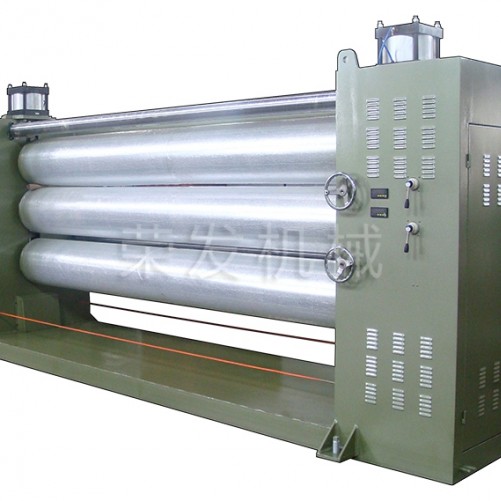
Kaiping Rongfa Machinery Co., Ltd. is a manufacturer specializing in the R&D and production of non-woven fabric machinery. Our hot presses are constructed from high-quality steel and operate within a temperature range of ambient to 250°C. We guarantee product quality, and customers can purchase with confidence.
(The images and text on this website are sourced from the internet. If any displayed information infringes upon your copyright or other legal rights, please notify us immediately, and we will promptly remove the content.)